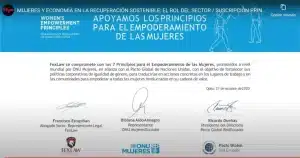
FEXLAW ABOGADOS signs the 7 Principles for Women’s Empowerment.
Empowering women to participate fully in all sectors and at all levels of economic activity is essential for:
- Building strong economies;
- Establishing more stable and just societies;
- Achieving internationally agreed development, sustainability, and human rights goals;
- Improving the quality of life for women, men, families, and communities; and
- Promoting business practices and objectives.
Even today, ensuring that women’s talents, skills, experiences, and energies are fully incorporated requires the implementation of international actions and decisive policies. The 7 Principles for Women’s Empowerment offer a set of reflections designed to help the private sector focus on key elements for promoting gender equality in the workplace, in the marketplace, and in the community.
Improving and expanding the inclusion and incorporation of women through business policies and practices requires techniques, tools, and skills that generate results. The Women’s Empowerment Principles, developed through a multilateral consultative process under the auspices of UN Women and the United Nations Global Compact, offer a “gender lens” that enables businesses to measure and analyze ongoing initiatives, benchmarks, and evaluation practices.
Based on real-life business practices, the Principles are intended to help companies modify their current policies and programs—or create new ones, if necessary—to achieve women’s empowerment. In addition, the Principles also reflect the interests of governments and civil society and will serve to support interactions between the parties involved, as gender equality requires the participation of all stakeholders. UN Women, a leading organization in the fight for gender equality, brings several decades of experience to this collaboration, designed jointly with the United Nations Global Compact, in what is the world’s largest corporate civic responsibility initiative involving 8,000 companies, as well as other stakeholders in more than 135 countries.
There is no doubt that in this increasingly globalized and interconnected world, the key to success lies in the use of all social and economic resources. However, the progress achieved does not prevent women from continuing to face discrimination, marginalization, and exclusion, despite the fact that equality between men and women is recognized internationally as a fundamental and inviolable human right. Almost all countries have ratified this value by recognizing the standards set forth in international human rights treaties that articulate a wide range of civil, political, economic, social, and cultural rights at the state level. A series of documents underscores the responsibilities of states to protect the human rights of women, indigenous peoples, children, workers, and persons with disabilities. In addition, the international ratification of documents such as the Beijing Platform for Action, adopted by 189 countries at the Fourth World Conference on Women in 1995, and the Millennium Declaration, adopted by 189 countries in 2000, also contribute to the indispensable implementation of the human rights framework.
These international standards illuminate our common aspiration to enjoy a life where opportunities are equal for all, where people can live free from violence, exercise their right to legal redress and compensation, and count on states to fulfill their obligation to respect and protect the human rights of women, men, and children, as well as to provide adequate public services such as education and health care.
These conventions inform national laws and enable the establishment of common values adopted by all global institutions. For their part, leading companies (in close collaboration with their counterparts, governments, non-governmental organizations, and the United Nations) seek to apply these international standards in favor of individual rights by implementing programs and policies specifically designed for this purpose. Their corporate commitment, which is reflected in the companies’ mission statements and supported by public monitoring of their policies and practices, demonstrates a growing awareness of the importance of these values for economic activity and their communities.